| Min. price: | 1 lb price: | Cust1 price: | Cust2 price: | Max. price: |
| Min. quant.: | 1 lb quant: | Cust1 quant: | Cust2 quant: | Max.quant: |
Detailed Listing For:
Botanical Name:
Agrimonia Eupatoria
Family:
ROSACEAE
Genus:
Agrimonia
Species:
eupatoria
Common Name:
Agrimony, Common Agrimony, Church Steeples, Sticklewort, Cockeburr, Stickwort
Lot#:
9501
Quantity:
1.64 lb
Avg Count Packet:
109
Average Seeds Per Pound:
22,246
Germination:
91%
Germination Test Type:
Purity:
98%
Height:
1-2 feet
Collection Locale:
Hungary
Minimum Hardiness Zone:
1 pkt
$
8.95
1 lb
$
65.45
Characteristics
Dye Plant
Herbaceous
Honey Bee Food
Medicinal
Perennial
Wild Flower
Wildlife food
Growing Info
Scarification
Soak in water, let stand in water for 24 hours.
Stratification
cold stratify for 7 days
Germination
surface sow and keep moist
Description
Botanical.com, A Modern Herbal states: From the long, black and somewhat woody perennial root, the erect cylindrical and slightly rough stem rises 1 or 2 feet, sometimes more, mostly unbranched, or very slightly branched in large specimens. The leaves are numerous and very rich in outline, those near the ground are often 7 or 8 inches long, while the upper ones are generally only about 3 inches in length. They are pinnate in form, i.e. divided up to the mid-rib into pairs of leaflets. The graduation in the size and richness of the leaves is noticeable: all are very similar in general character, but the upper leaves have far fewer leaflets than the lower, and such leaflets as there are, are less cut into segments and have altogether a simpler outline. The leaflets vary very considerably in size, as besides the six or eight large lateral leaflets and the terminal one, the mid-rib is fringed with several others that are very much smaller than these and ranged in the intervals between them. The main leaflets increase in size towards the apex of the leaf, where they are 1 to 1 1/2 inches long. They are oblong-oval in shape, toothed, downy above and more densely so beneath.
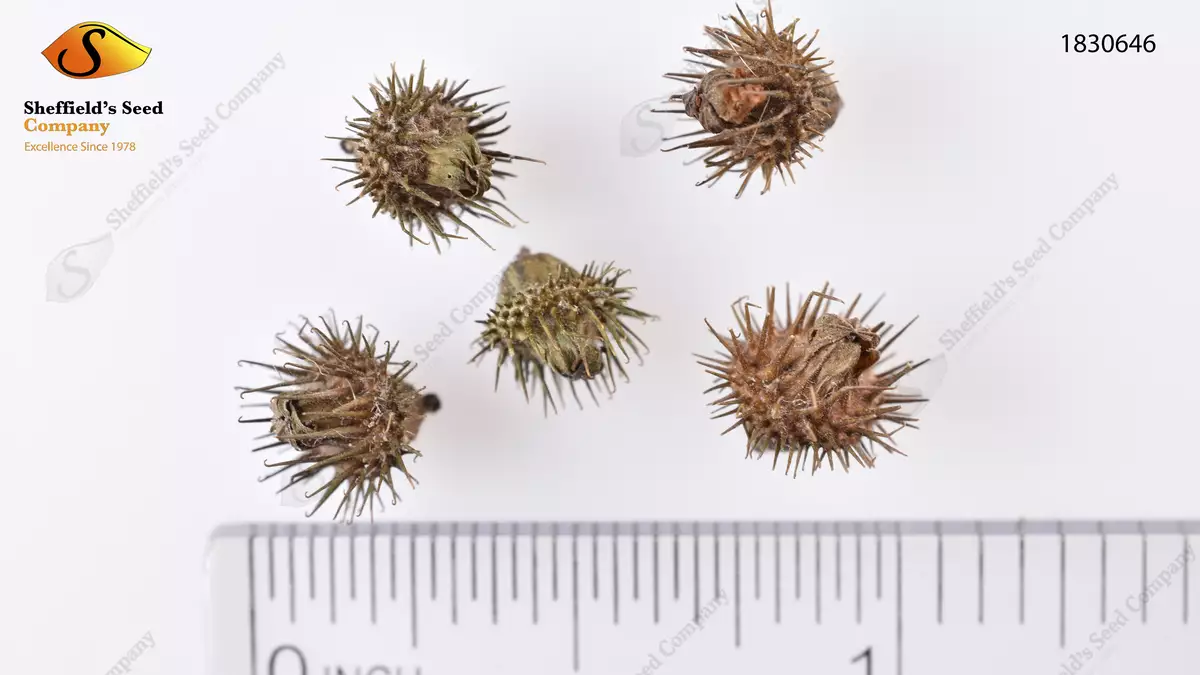
The flowers, though small, are numerous, arranged closely on slender, terminal spikes, which lengthen much when the blossoms have withered and the seed-vessels are maturing. At the base of each flower, which is placed stalkless on the long spike, is a small bract, cleft into three acute segments. The flowers, about 3/8 inch across, have five conspicuous and spreading petals, which are egg-shaped in form and somewhat narrow in proportion to their length, slightly notched at the end and of a bright yellow colour. The stamens are five to twelve in number. The flowers face boldly outwards and upwards towards the light, but after they have withered, the calyx points downwards. It becomes rather woody, thickly covered at the end with a mass of small bristly hairs, that spread and develop into a burr-like form. Its sides are furrowed and nearly straight, about 1/5 inch long, and the mouth, about as wide, is surmounted by an enlarged ring armed with spines, of which the outer ones are shorter and spreading, and the inner ones longer and erect.
The whole plant is deep green and covered with soft hairs, and has a slightly aromatic scent; even the small root is sweet scented, especially in spring. The spikes of flowers emit a most refreshing and spicy odour like that of apricots. The leaves when dry retain most of their fragrant odour, as well as the flowers, and Agrimony was once much sought after as a substitute or addition to tea, adding a peculiar delicacy and aroma to its flavour. Agrimony is one of the plants from the dried leaves of which in some country districts is brewed what is called 'a spring drink,' or 'diet drink,' a compound made by the infusion of several herbs and drunk in spring time as a purifier of the blood. In France, where herbal teas or tisanes are more employed than here, it is stated that Agrimony tea, for its fragrancy, as well as for its virtues, is often drunk as a beverage at table.
The plant is subject to a considerable amount of variation, some specimens being far larger than others, much more clothed with hairs and with other minor differences. It has, therefore, by some botanists, been divided into two species, but the division is now scarcely maintained. The larger variety, having also a greater fragrance, was named Agrimonia odorata.
The long flower-spikes of Agrimony have caused the name of 'Church Steeples' to be given the plant in some parts of the country. It also bears the title of 'Cockeburr,' 'Sticklewort' or 'Stickwort,' because its seed-vessels cling by the hooked ends of their stiff hairs to any person or animal coming into contact with the plant. It was, Gerard informs us, at one time called Philanthropos, according to some old writers, on account of its beneficent and valuable properties, others saying that the name arose from the circumstance of the seeds clinging to the garments of passers-by, as if desirous of accompanying them, and Gerard inclines to this latter interpretation of the name.
The whole plant yields a yellow dye: when gathered in September, the colour given is pale, much like that called nankeen; later in the year the dye is of a darker hue and will dye wool of a deep yellow. As it gives a good dye at all times and is a common plant, easily cultivated, it seems to deserve the notice of dyers.
Sheep and goats will eat this plant, but cattle, horses and swine leave it untouched.
Comments
Perennial; small yellow flowers; source of a golden-yellow dye